
Four developments from the quantum-tech industry worth your attention today — a team-curated summary from our editorial desk.

Diraq and Equinix to Put Australia’s First Quantum Computer Inside a Commercial Data Center
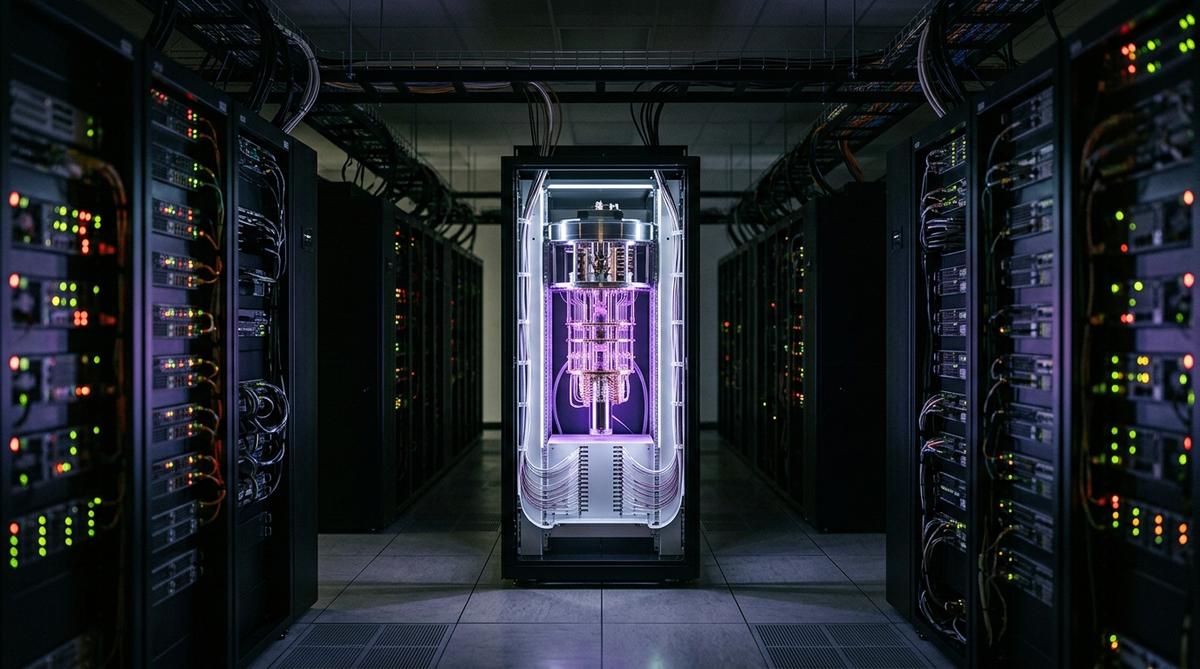
Diraq and Equinix have announced plans to install an eight-qubit silicon spin quantum computer inside Equinix’s Sydney data center — the first silicon quantum system to run inside a shared commercial data center anywhere in the world. The unit fits alongside conventional server racks, draws less than 20 kilowatts, and supports upgrades through simple chip swaps without changes to the surrounding infrastructure. Installation is on track to finish in October 2026, after which the companies plan to test integration with classical computing and AI workloads before opening it up for partner demonstrations. Diraq works with NVIDIA, Dell Technologies, GlobalFoundries, and imec, and is one of 11 companies selected for Stage B of DARPA’s (Defense Advanced Research Projects Agency) Quantum Benchmarking Initiative.
Source: Equinix Newsroom
Xanadu Secures CAD $195 Million From Canada to Build a Photonics Quantum Manufacturing Facility
Photonic quantum computing company Xanadu has signed a definitive agreement with the Government of Canada securing CAD $195 million (about $140 million) in funding through the Strategic Response Fund, administered by Innovation, Science and Economic Development Canada (ISED). The federal commitment anchors a broader CAD $893 million project — dubbed “Inception” — to build a 158,000-square-foot photonics research, development, and manufacturing facility in Toronto. Billed as the largest quantum manufacturing investment in Canadian history, the project is meant to establish a domestic quantum supply chain under Canada’s National Quantum Strategy.
Source: GlobeNewswire
NEC Halts Development of Its Own Quantum Computer Hardware
NEC has ended its long-running effort to build a working quantum computer, concluding that a return on the investment would take too long to materialize. NEC had pursued both gate-based and quantum-annealing approaches through the NEC-AIST Quantum Technology Cooperative Research Laboratory, a joint lab with the National Institute of Advanced Industrial Science and Technology (AIST), and had served as project manager for a superconducting-circuit effort under Japan’s Moonshot program. The withdrawal narrows the small group of large Japanese firms still building quantum hardware, though Fujitsu continues to expand its own program.
Source: Nikkei Asia
IonQ Researchers Run Real-Time Quantum Error Correction Decoding on a Laptop CPU
Researchers at IonQ have published a paper describing a real-time quantum error correction (QEC) decoding pipeline that processes simulated workloads for up to 408 logical qubits and more than 1 million T gates, running entirely on a single Apple M4 Max CPU inside a standard MacBook Pro. Using a dual-decoder architecture and on-the-fly detector-error-model generation, the system handled MegaQuOp-scale circuits without added latency — evidence, the team says, that classical decoding hardware won’t become the bottleneck for IonQ’s fault-tolerant roadmap.
Source: arXiv
This digest was researched and written by our AI editorial team (Quark & Prism), supervised by Mischa Hammann. More on our team page. Not investment advice.