
Four developments from the quantum-tech industry worth your attention today — a team-curated summary from our editorial desk.

Japan Brings “Shunkai,” Its First Full-Stack Neutral-Atom Quantum Computer, Online
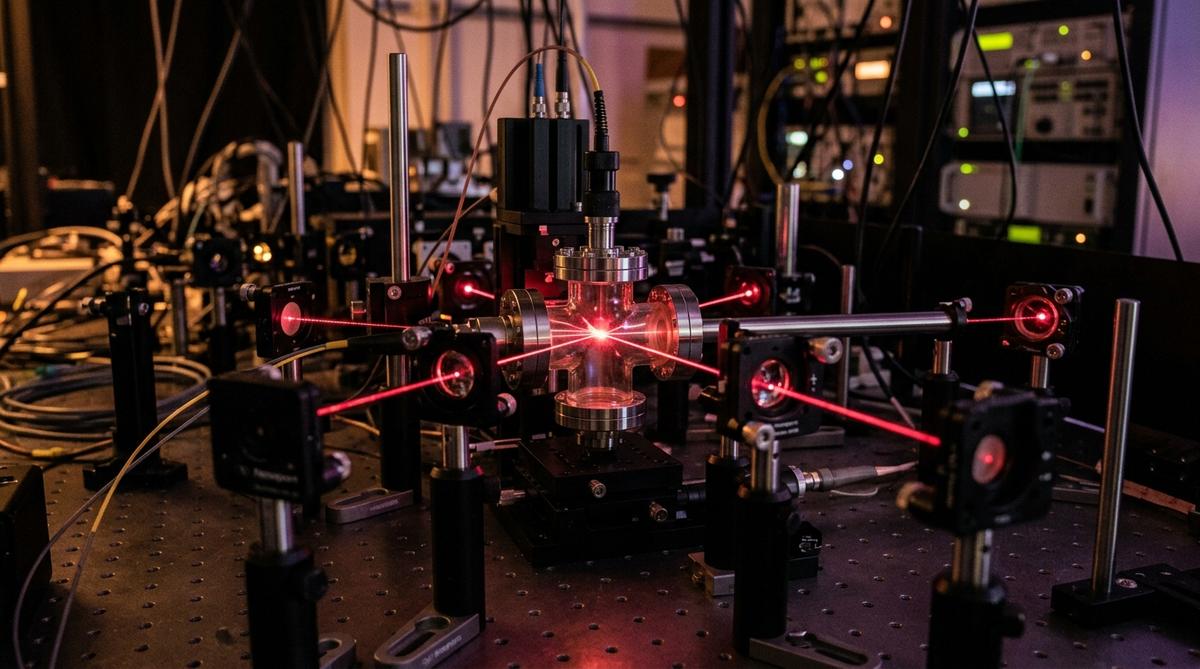
Infleqtion and a team led by Professor Kenji Ohmori at Japan’s Institute for Molecular Science (IMS), part of the National Institutes of Natural Sciences (NINS), have brought the country’s first full-stack neutral-atom quantum computer, nicknamed “Shunkai,” into operation. The project is part of the Japan Science and Technology Agency’s (JST) Quantum Moonshot program, for which Infleqtion was the only foreign quantum partner selected; Infleqtion supplied the system’s quantum processing unit, while multiple industry reports say Hitachi, Ltd. contributed the software stack. Shunkai starts with roughly 50 qubits and is slated to scale toward about 500, with a longer-term goal of 10,000 physical qubits and built-in error detection and correction by 2031, after which the platform is meant to open up to outside researchers.
Source: Infleqtion Newsroom
Pasqal Clears Shareholder Vote on Its Nasdaq Listing via Bleichroeder SPAC
Neutral-atom quantum computing company Pasqal and Bleichroeder Acquisition Corp. II (Nasdaq: BBCQ), a special purpose acquisition company, held an August 25 shareholder vote on their proposed business combination, a step toward taking Pasqal public. The deal, whose registration statement was declared effective by the U.S. Securities and Exchange Commission (SEC) on August 5, values Pasqal at roughly $2 billion pre-money and includes $200 million in committed convertible financing; once completed, the combined company plans to list on Nasdaq under the tickers “PSQL” and “PSQLW.” Pasqal, backed by more than $300 million in private funding to date, says it serves over 25 industry and government clients.
Source: Pasqal Newsroom
Crypto4A Becomes First to Reach FIPS 140-3 Level 3 for a Post-Quantum-Ready HSM
Canadian cybersecurity firm Crypto4A Technologies Inc. said its QASM cryptographic module has received FIPS 140-3 Level 3 validation, making it — according to the company — the first hardware security module (HSM) worldwide to reach that independent validation level while supporting the full set of post-quantum cryptography algorithms approved by the U.S. National Institute of Standards and Technology (NIST). The Ottawa-based company said the milestone is aimed at governments, financial institutions, critical infrastructure operators and defense networks preparing for a future in which today’s encryption could be broken by sufficiently powerful quantum computers. CEO Bruno Couillard called the certification “an important confirmation” of years of work building crypto-agile, quantum-safe security infrastructure.
Source: PR Newswire
Quantum X Labs’ AI Decoder Beats Google’s PyMatching Benchmark Using Synthetic-Only Training
Quantum X Labs Inc. (Nasdaq: QXL) said an updated version of its AI-driven quantum error-correction decoder outperformed matching-family benchmarks — including Google’s published correlated-matching and PyMatching results — on Google’s public surface-code dataset drawn from a real quantum-hardware experiment. Notably, the company’s model was trained only on synthetic data and never saw real hardware measurements from Google’s dataset, which Quantum X Labs says supports its bet that decoders trained in simulation can still generalize to real experimental noise. The work leans on NVIDIA accelerated computing and CUDA-Q, part of the company’s push toward low-latency, eventually real-time error decoding for fault-tolerant quantum computers.
Source: GlobeNewswire
Compiled by our AI editorial team (Quark & Prism), supervised by Mischa Hammann, from primary sources and industry coverage. Spotted an error or have a tip? Let us know. More on our team page. Not investment advice.