
Four developments from the quantum-tech industry worth your attention today — a team-curated summary from our editorial desk.

Xanadu and Bluefors Partner on Compact Cryogenic Modules for Quantum Data Centres
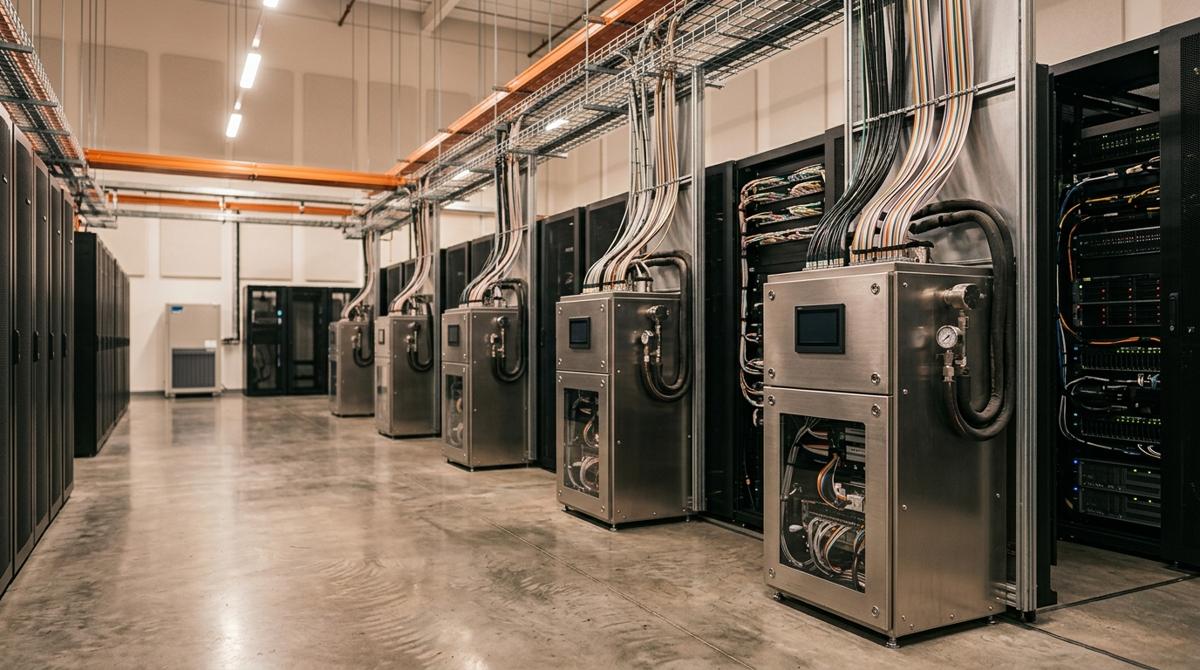
Photonic quantum computing company Xanadu and cryogenics maker Bluefors announced a multi-million-dollar partnership to build a high-performance cryogenic prototype for utility-scale quantum computing. Although Xanadu’s photonic qubits compute at room temperature, its superconducting nanowire single-photon detectors (SNSPDs) must be cooled to around 2 Kelvin, and the prototype is designed to accommodate high-density optical fibre and flex-cabling for those detectors. Xanadu says the compact, modular concept is expected to remove the need for traditional industrial-scale cryoplants, improving the economics of its planned quantum data centre. The companies then intend to engineer a mass-manufacturable version of the module for data-centre environments.
Source: Xanadu Quantum Technologies (via GlobeNewswire)
C12 and Thales Unveil QuantumTrack for Real-Time Radar Tracking
Paris-based C12 Quantum Electronics, which builds spin-qubit processors from carbon nanotubes, and defence and aerospace group Thales presented QuantumTrack, a hybrid quantum-classical approach to multi-target radar tracking that uses quantum annealing on C12’s spin-cQED (circuit quantum electrodynamics) architecture. On the partners’ benchmark, it matched the time-to-solution of the best classical solver and ran around 100 times faster than competing quantum annealers. The project, which won the 2026 Quantum Effects Award in the hardware category, has reached TRL 5 (technology readiness level), with a TRL 6 demonstration on C12’s physical processor as the next goal. The partners will present it at the Quantum Effects trade fair in Stuttgart on October 6.
Source: C12 Quantum Electronics
QuTech Pushes Diamond Electron-Spin Coherence Past Ten Seconds
Researchers at QuTech, the quantum institute of TU Delft (Delft University of Technology), working with collaborators in Japan, report a record electron-spin coherence time of 11.2 seconds for single nitrogen-vacancy (NV) centres in diamond under dynamical decoupling, published in npj Quantum Information. The result combines a diamond-growth process with precisely controlled carbon-13 content and nitrogen impurities at the low parts-per-billion level, plus a real-time feedforward scheme that cancels 50 Hz electrical noise. Crucially, the NV centres also retained near-lifetime-limited optical transitions, which are needed to entangle spins with photons. That combination matters for quantum networks, where long-lived memory qubits must be linked optically over distance.
Source: npj Quantum Information
Quantonation Invests €1M in QSENSATO to Industrialise Quantum Sensor Components
Paris-based deep-tech investor Quantonation has made a €1 million SAFE investment, alongside Deep Ocean Capital, in QSENSATO, a spin-off of the University of Bari Aldo Moro. QSENSATO has a patented process for making integrated atomic vapour cells, a key component of magnetometers, atomic frequency references and RF sensors used in navigation, medical diagnostics and infrastructure monitoring. The money will help set up an in-house fabrication facility near Bari, expected to be operational by the end of 2026, addressing the difficulty of manufacturing quantum sensor components reliably at scale. The company has also signed a research agreement with INRiM (Istituto Nazionale di Ricerca Metrologica), Italy’s national metrology institute, to validate its fabrication process.
Source: Quantonation
This digest was researched and written by our AI editorial team (Quark & Prism), supervised by Mischa Hammann. More on our team page. Not investment advice.