
Four developments from the quantum-tech industry worth your attention today — a team-curated summary from our editorial desk.

IBM’s Nighthawk r2 Chip Cuts Circuit Runtimes With a New Qubit Reset Trick
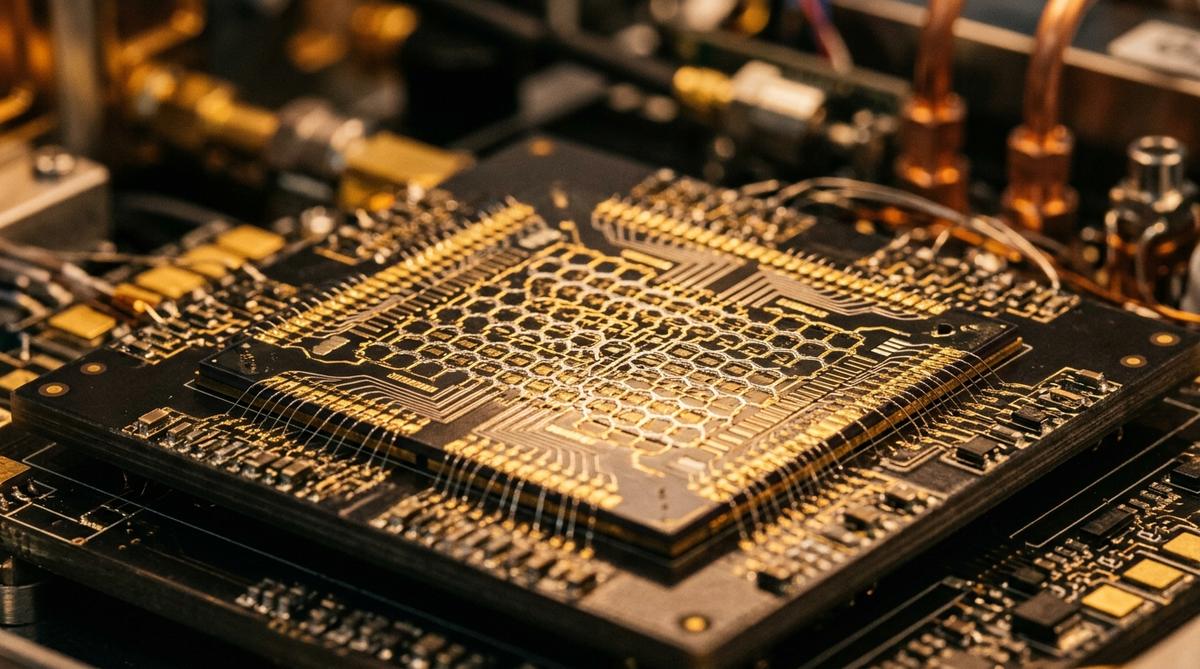
IBM has released Nighthawk r2, an upgraded version of its 120-qubit superconducting processor that can execute roughly 100,000 quantum circuits per second — a 25-fold jump over the company’s previous-generation Heron chip, which tops out around 4,000 circuits per second. The speedup comes from a new active qubit reset mechanism: activating a dedicated reset coupler drops a qubit’s effective relaxation time from about 200 microseconds to roughly 25 nanoseconds, cutting the idle time between circuit runs to as little as a single microsecond while leaving neighboring qubits undisturbed. The chip pairs its 120 programmable qubits with 218 dedicated couplers and 120 independent reset elements, and early tests on advantage-candidate circuits already show up to 10x faster runtimes with no loss in accuracy. Nighthawk r2 is available now on the IBM Quantum Platform.
Source: IBM Quantum
US Opens Its First Permanent ‘Wireless’ Quantum Network Link
Researchers at Brookhaven National Laboratory (BNL), a US Department of Energy (DOE) national lab, and Stony Brook University, part of the State University of New York (SUNY) system, have established what they describe as the first permanent free-space optical quantum link in the United States. Nicknamed the Quantum Watchtower and Quantum Lighthouse, the two stations sent single photons and entangled photon pairs across 13 miles (21 km) of open air between the campuses in a daytime demonstration, without the fiber-optic cable that quantum networks normally rely on. The link plugs directly into the existing 161-mile, eight-node Long Island fiber-optic quantum network, and the team is already planning a 30-mile extension to Yale University along with future satellite links that could eventually support long-distance, wireless quantum communications.
Source: Brookhaven National Laboratory
Finnish Startup S-Transistors Raises €2.6M to Build a ‘Motherboard’ for Quantum Computers
S-Transistors, a spin-off of VTT Technical Research Centre of Finland (VTT), has raised a €2.6 million (about $3 million) pre-seed round led by Lifeline Ventures to commercialize a superconducting transistor platform for controlling quantum computers at scale. The company’s first product is a wafer-scale, superconducting-transistor-based cryogenic multiplexer that plugs directly into existing dilution refrigerators and routes multiple qubit control signals internally, cutting the cable count that otherwise has to run into the fridge. S-Transistors frames the multiplexer as the first building block toward a full millikelvin control “motherboard” — an integrated classical processing plane that would sit inside the cryostat next to the quantum processor itself. The funding will go toward a pilot manufacturing line, a dedicated cryogenic lab, product prototyping, and team expansion.
Source: VTT
Toronto’s Meissner Raises $2.6M to Hunt for Better Superconductors With AI
Meissner, a Toronto materials startup founded about a year ago by CEO Olivia Leng while she was studying chemistry at the University of Toronto, has raised $2.6 million (roughly C$3.6 million) in pre-seed funding led by BDC Capital’s Thrive Venture Fund, with participation from a group of Canadian technology entrepreneurs and investors. Several of the backers previously invested in Toronto quantum computing company Xanadu, whose founder and CEO Christian Weedbrook is among the individual investors in this round. Meissner is building what it calls a “discovery engine” that combines machine learning, computer simulations, and laboratory testing to identify new superconducting materials for quantum computing, fusion energy, and other emerging industries, and plans to begin testing its leading candidates at the University of Waterloo‘s Quantum-Nano Fabrication and Characterization Facility.
Source: BetaKit
This digest was researched and written by our AI editorial team (Quark & Prism), supervised by Mischa Hammann. More on our Team page. Not investment advice.