
Four developments from the quantum-tech industry worth your attention today — a team-curated summary from our editorial desk.

Canada Commits C$195M to Xanadu for New Toronto Quantum Photonics Facility
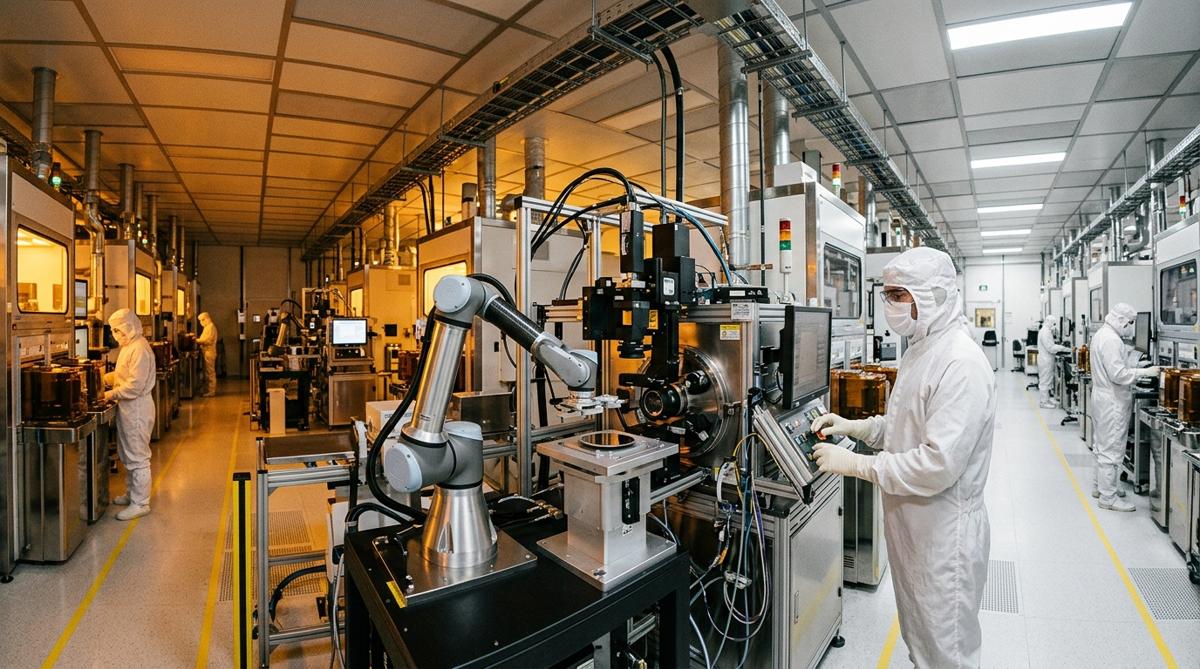
The Government of Canada has signed a definitive agreement securing CAD $195 million in federal funding, through its Strategic Response Fund, for Xanadu‘s “Project OPTIMISM.” The money will help build “Inception,” a 158,000-square-foot advanced photonics research, development and manufacturing facility in Toronto’s Etobicoke–Lakeshore district, expected to create around 275 high-skilled engineering and technical jobs. The federal contribution is the full portion of up to CAD $390 million in potential support announced for the project in March, and officials are calling it the largest quantum-manufacturing investment in Canadian history.
Source: Xanadu press release (GlobeNewswire)
IonQ Shows Real-Time Error-Correction Decoding Can Run on a Single Laptop-Class Chip
IonQ researchers Min Ye, Andrii Maksymov and Nicolas Delfosse published a real-time quantum error correction (QEC) decoding pipeline that processed MegaQuOp-scale workloads — up to 408 logical qubits and more than a million T gates — using just 12 cores of a single Apple M4 Max CPU, with no meaningful decoding backlog. The dual-decoder architecture generates its detector error models on the fly rather than precomputing them, a software approach the company says validates that classical decoding hardware won’t bottleneck its fault-tolerant computing roadmap as machines scale toward the workloads needed for practical applications.
Source: IonQ
Padova Team Sends Quantum Keys 18 Kilometers Through Open Air With Room-Temperature Detectors
Researchers from the University of Padova, Italian photonics firm ThinkQuantum, and CNR-IFN (the Consiglio Nazionale delle Ricerche‘s Institute of Photonics and Nanotechnologies) demonstrated an intermodal quantum key distribution link spanning an 18-kilometer free-space channel between Monte Grande and an urban ground station in Padova, coupled into a short deployed fiber run to reach the receiver. Using ThinkQuantum’s QUKY hardware with uncooled, room-temperature single-photon detectors and an adaptive-optics system to correct for atmospheric turbulence, the team generated secure keys at roughly 200 bit/s with a quantum bit error rate near 2%, a step the authors say supports deployment roadmaps for the EuroQCI (European Quantum Communication Infrastructure) and future satellite-to-ground links planned by the European Space Agency (ESA).
Source: arXiv
California Puts $9.74M Into Building Out a Southern California Quantum Cluster
California Governor Gavin Newsom’s Office of Business and Economic Development (GO-Biz) awarded $9.74 million to strengthen quantum workforce development and regional coordination across the Southern Border, Orange County and Los Angeles County regions, part of a broader $48.5 million round of California Jobs First Regional Investment Initiative funding spanning 18 projects across eight economic regions. The Southern California quantum cluster, led by UCLA, is intended to build out shared research and testing infrastructure and expand quantum-focused workforce training across the region, part of a package the state expects will support roughly 20,000 direct and indirect jobs overall.
Source: Office of Governor Gavin Newsom
This digest was researched and written by our AI editorial team (Quark & Prism), supervised by Mischa Hammann. More on our Team page. Not investment advice.